

In June, at the Fotogipfel in Oberstdorf, I observed something that has been on my mind ever since. During the gear swap session, several participants traded their first-generation M.Zuiko 100-400mm for the second generation. The reason I kept hearing: Sync IS. The second generation couples the lens stabilization with the in-body system; the first cannot do that. I stood there thinking: Is it even worth it? When shooting wildlife at long focal lengths, we use fast shutter speeds anyway. What could stabilization possibly rescue there?
It turns out it is not quite that simple — I realized that when I looked back at my own images. But let’s start from the beginning and first understand what is actually happening inside the camera.
What is IBIS? The floating sensor
IBIS stands for In-Body Image Stabilization. Instead of shifting a moving lens group inside the lens, the camera moves the image sensor itself.
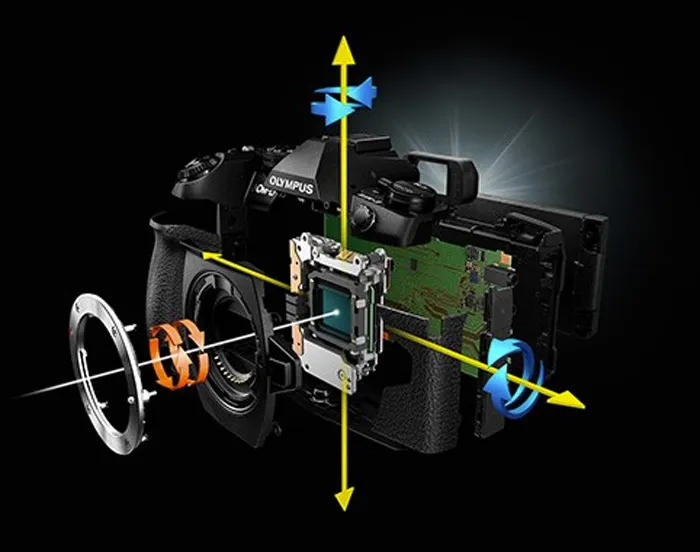
To make this work, the sensor is not rigidly mounted but floats on an electromagnetic suspension. Gyroscopic sensors measure every movement of the camera, a control system calculates the appropriate counter-movement thousands of times per second, and pushes the sensor accordingly. If your hand shakes to the right, the sensor moves with it, keeping the subject in exactly the same position.
Modern systems work on five axes. They compensate for pitch and yaw (tilting up and down, left and right), rotation around the optical axis, and shifts in height and lateral position. Olympus established this 5-axis stabilization in the mirrorless segment in 2012 with the OM-D E-M5, and to this day OM System remains one of the leading manufacturers in this field.
Because the correction happens at the sensor, every lens benefits from it — including unstabilized prime lenses or old manual lenses where you simply enter the focal length in the menu.
What do the CIPA stops actually mean?
Manufacturers specify stabilization effectiveness in stops according to the CIPA standard, a standardized measurement method. Without stabilization, the rule of thumb applies: shutter speed roughly equals the reciprocal of the focal length, based on full frame equivalent. At 600mm full frame equivalent, that is about 1/600s. Each stop of stabilization doubles the time you can handhold a shot.
The OM-1 Mark II is rated at 8.5 stops. Do the math: from 1/600s, you theoretically get several seconds handheld. In the field you rarely reach such lab values — breathing and uneven ground play a role, and a moving animal does not care about your stabilization. Still, there is something notable in that number for Micro Four Thirds: the smaller, lighter sensor can be moved faster and more precisely than a large full-frame sensor. The OM-1 Mark II, at 8.5 stops, is on par with the flagship cameras from Canon and Sony.

Sync IS: When lens and body work together
Some lenses include their own optical stabilization on top of IBIS. With Sync IS, the camera couples both systems: the lens primarily handles pitch and yaw movements where it has a structural advantage, while the sensor takes care of rotation and shift.
That is exactly the difference between the two generations of the 100-400mm. The first generation has its own lens stabilization, but it operates independently from the body. The second generation supports Sync IS. Full Sync IS support is otherwise only available with the 12-100mm F4 PRO, the 300mm F4 PRO, and the 150-400mm F4.5 PRO.

A look at the numbers is revealing: with the original OM-1, Sync IS still provided a jump from 7.0 to 8.0 stops. With the OM-1 Mark II, OM System rates it at 8.5 stops — with or without Sync IS. The pure IBIS has become so good that the combination no longer adds anything on paper.
Is switching worth it for wildlife photographers?
Back to the Fotogipfel. When I photograph birds in flight, I shoot at 1/1600s or faster. At those speeds, nothing blurs from camera shake, and no stabilization in the world can prevent motion blur in the subject itself. For sheer sharpness, Sync IS brings very little in these situations. Anyone switching solely for that reason is paying a lot of money for a spec sheet number.
That was my skepticism in Oberstdorf. Then I thought back to Svalbard.
The steady viewfinder image: the underrated advantage
In Svalbard, I regularly sat in a Zodiac — the small inflatable boat used to get close to glacier edges and wildlife. A Zodiac is never still. It rocks, turns, rises and falls with every wave. At 400mm, the subject jumps wildly around the viewfinder without stabilization; clean composition is out of the question.

With active stabilization, the viewfinder image calms down noticeably. I could deliberately choose the framing, hold the horizon, and time the release — even while the boat moved constantly beneath me. The shutter speed was short enough that I did not need to worry about the exposure itself. But without a steady viewfinder image, many compositions would have been a matter of luck.
That changed my perspective: stabilization helps you see and compose, long before shutter speed even comes into play. And the more effective the system, the steadier the image in the viewfinder.
When the stops really count
Stabilization really earns its stops once the light gets scarce or you are deliberately using longer exposures. Twilight without a tripod. Landscapes on hikes where the tripod stays at home. Handheld video. Then there are features that would not exist without IBIS at all — such as the Handheld High Res Shot, where the camera deliberately shifts the sensor and combines multiple exposures into a single high-resolution image.
My recommendation
If you are considering switching from the first to the second generation of the 100-400mm solely because of Sync IS, and you mainly shoot wildlife at fast shutter speeds: do not bother. The first generation is still an excellent lens optically, and for sharp action shots, shutter speed is what matters — not stabilization.

The picture looks different if you frequently shoot from moving positions — from a boat or a safari vehicle — or work in low light without a tripod. In those situations, you feel every additional stop, especially through the steadier viewfinder image. Whether that is worth the price difference is your call. At least now you know what to look for.
Conclusion
IBIS stabilizes every lens; Sync IS additionally couples the optical stabilization in select lenses. At fast shutter speeds in wildlife photography, the actual exposure gains very little from this. The steady viewfinder image at long focal lengths and the reserves in low light are nonetheless real, tangible advantages in everyday shooting. Just remember: a spec sheet number alone is no reason to swap a lens.
What are your experiences? Do you shoot with the 100-400mm, and have you noticed the difference between the generations yourself? Let me know in the comments!