In a July 2025 interview with PetaPixel, Eiji Shirota (Head of Product Management, Product Planning & Product Strategy at OM Digital Solutions) explained why OM Digital Solutions is considering AI upscaling instead of developing a higher-resolution sensor for a new camera. The reasoning is that the larger data volumes from a higher-resolution sensor would make the computational functions of OM System cameras unacceptably slow. Technically, I’m not convinced by that argument. Beyond the technical progress made since the OM-1 launched in 2022, there is also a second, psychological reason why OM Digital Solutions should introduce a camera with a new sensor and a new image processor now.
A Decade of Unchanged Sensor Resolution
Hard to believe, but sensor resolution at Olympus / OM Digital Solutions has been stuck at 20.3 megapixels since 2016, when the E-M1 Mark II was introduced. The OM-1, launched in early 2022, does have a technologically newer sensor (stacked BSI) that improves both readout speed and image quality, but the resolution stayed the same. At the time, this was justified by saying the new sensor delivered a perfect balance of resolution, speed, and image quality.

In the PetaPixel interview, OM Digital Solutions itself points out that many of its photographers are wildlife and bird photographers. These users need more resolution so they can potentially reframe a shot after the fact. Purists will now object: a good photographer should nail the framing at the moment of capture. But those people have probably never tried to photograph a bird. Unlike human models, animals mostly don’t do what the photographer wants. Often you’re simply glad to have captured the animal at all, and you sort out the composition afterwards.
Speed and Resolution Aren’t a Trade-off
OM Digital Solutions’ main argument for using AI upscaling instead of developing a higher-resolution sensor is speed. Naturally, the files produced by a higher-resolution sensor are larger and take longer to process. According to OM Digital Solutions, this would be unacceptably slow specifically for its computational functions, such as Live ND. That would undermine one of the key selling points of OM System cameras. I don’t find this argument convincing, though. It only holds if you pair a new sensor with the existing TruePic X processor. But the TruePic X has now been on the market for more than four years (introduced with the OM-1 in early 2022). Under Moore’s Law, semiconductor speed roughly doubles every 18-24 months. That means OM Digital Solutions could process a data volume four times larger at the same speed.
To anyone now dreaming of an 80-megapixel sensor: on Micro Four Thirds, a sensor like that wouldn’t make sense. The physical limit is diffraction. Under the Rayleigh criterion (λ ≈ 0.55 µm), at the current pixel size of roughly 3.3 µm (20 megapixels on the MFT sensor), the diffraction-limited aperture sits at around f/5. Beyond that point, more resolution no longer yields additional detail. At roughly double the resolution, around 32 megapixels, that value would drop to about f/3.9.

That sounds like a tight margin, but it isn’t. OM System’s reference wildlife lenses – the M.Zuiko Digital 150-400mm F4.5 PRO, the 300mm F4 PRO, and the 40-150mm F2.8 PRO – are all faster than f/3.9. Wildlife photographers mostly shoot at wide apertures, since that delivers good subject separation and short shutter speeds, both essential. So there is still headroom for more resolution. A jump to roughly 28 to 32 megapixels would therefore be usable. An 80-megapixel sensor, on the other hand, would not: the photographer would get a bigger file, but diffraction means not meaningfully more detail.
With a sensor in that range and a new image processor, it should also be possible to boost processing speed, not just resolution. Other manufacturers, like Sony, demonstrate this regularly: with new sensor and processor generations, they manage to increase both at once instead of trading one off against the other.
Why AI Upscaling Doesn’t Make a Difference
In the interview, Eiji Shirota himself mentions that in-camera upscaling should work similarly to existing software solutions like Photoshop or DxO – just better, because OM Digital Solutions already has access to the data much earlier in the processing pipeline. That’s fundamentally the same thinking as with AI-based noise reduction, which I’ve covered before. There, too, software doesn’t replace a physically better data foundation. It just works more intelligently with what the sensor delivers.
Of course, I can’t judge the actual quality at this point, and I can only take Eiji at his word here. Still, I doubt that any quality edge would hold up for long given the current pace of AI development. AI upscaling also takes time to compute: for the Canon R1, reportedly several seconds. The Canon R1 launched in early 2025. In my assessment, OM Digital Solutions won’t be able to avoid a new image processor, even if it goes the AI-upscaling route.
The Trust Question
This pattern isn’t new. Back in 2019, the E-M1X was already criticized for being built on components that were at least three years old. At the time, the manufacturer’s PR line was that it had found a “balance of image quality and megapixels.” Six years later, the argument in the PetaPixel interview sounds almost identical.
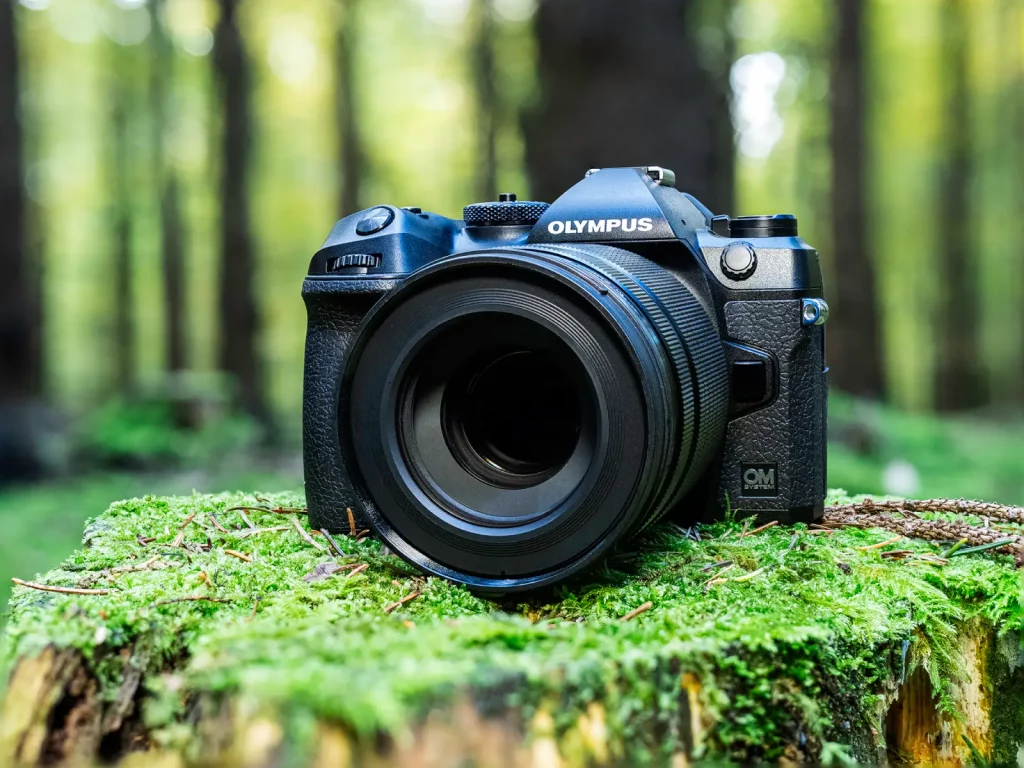
Ever since Olympus sold off its camera division in 2020 and OM Digital Solutions took over, a perception has persisted in the community that there’s no real new development anymore. In a widely discussed DPReview forum thread, users openly ask whether an OM System model with a new sensor will ever appear again. admiringlight.com likewise criticized the OM-3 as a rehash of OM-1 II components: same sensor, same TruePic X processor, same subject detection – just in a new body.
Reusing a sensor isn’t unusual in itself. Sony also puts the same sensor from the 2021 A1 into the A1 II. Panasonic used its S1 sensor from 2019 to 2024. The difference lies in the starting point: for Sony and Panasonic, the reused sensor was best-in-class at launch. For Olympus/OM System, the resolution wasn’t top-tier even back in 2016 – and today it actually trails entry-level full-frame cameras at 24 to 33 megapixels. That’s exactly what separates this criticism from simple whataboutism.
For a small, specialized manufacturer like OM Digital Solutions, that matters more than it would for a Sony or Canon with a broad portfolio. As a niche player, the company can least afford to give the impression that it can no longer, or no longer wants to, truly develop new technology. That damages trust in the OM System brand more than any single facelift camera.
Conclusion and Recommendation
I’m well aware that decisions about which direction to take involve more than just what’s technically feasible. For instance, OM Digital Solutions might be contractually obligated to Sony to purchase a certain number of OM-1-generation sensors. Without knowing about such constraints, and without knowing OM Digital Solutions’ financial situation, I would, from a purely technical standpoint, prefer a new, higher-resolution sensor combined with AI-assisted resolution enhancement. I’ve laid out the reasons above. The market-psychology angle certainly shouldn’t be underestimated either. That’s why I’m curious whether, on September 9, 2026 – rumored to be the announcement date for a new camera – we’ll actually see a model with a new sensor. It remains to be seen which direction OM Digital Solutions takes.
What do you think? I’d love to hear your perspective in the comments.