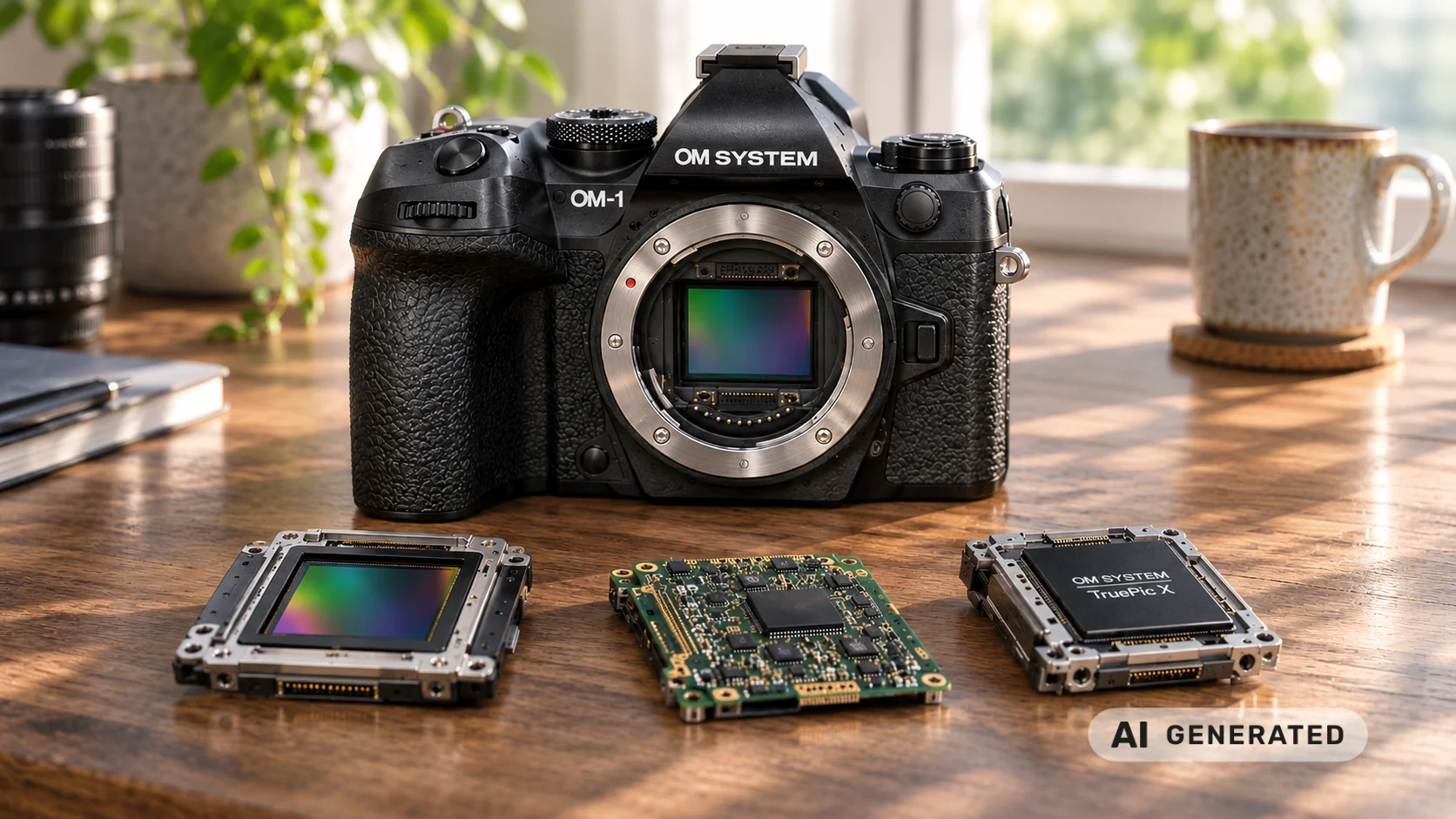
Do you still remember the Olympus Air A01? On the outside it was a Micro Four Thirds camera that used a smartphone to control its functions. Apart from a shutter button and the zoom ring, it had no controls at all and no display. But it was much more than that. There was also an SDK (Software Development Kit) that allowed developers to control the camera with their own software and thus explore new areas of application. In hindsight it wasn’t a profitable model, and so there was never a successor to the Olympus Air A01. Thanks to artificial intelligence, there are now a few projects that bring new functions to existing cameras. My article “Unofficial firmware for OM System cameras…” gives you a small glimpse into this. It gave me an idea: the modular camera.
Over the last few days I’ve thought about this a number of times, and my thoughts keep circling around this idea, which in my opinion could finally bring innovation back to the photo industry.
What does the modular camera look like?
Sensor and processor
After more than 100 years of photography, the user interface photographers use to operate a camera is more or less mature. Sure, there are one or two differences between brands, but essentially the individual brands don’t differ. Even within a single brand, the control concepts change very little. So cameras differ mainly in the sensor and the firmware, which is responsible for providing the functionality. What if a camera were designed so that the sensor, the processor and the board could be easily removed and replaced with a new version? I’m not thinking of the customer doing this themselves, as was originally planned with the Fairphone. No, the manufacturer could take care of that through its repair stations. The body and all controls would stay in place and wouldn’t have to be redesigned and produced again. When the board is swapped, the rest of the body could be overhauled at the same time.
Firmware
In addition to the hardware, the manufacturer would also open up the firmware and provide an interface. That would let users add functions themselves. Of course only within limits that make sure the hardware can’t be damaged. The initiatives that have recently been popping up to modify camera firmware show that there is a need for this. It’s also clear that not everyone is able to modify firmware. Those who can, however, would be on the safe side if it happened through a controlled interface. The manufacturer could also use a certificate to make sure that only approved modifications can be installed on the hardware. Review mechanisms similar to those Apple introduced for apps could safeguard this.
Advantages
As described above, this approach would have several advantages. Above all, it would be considerably easier on resources, and the hardware would stay in use much longer than before. In addition, photographers wouldn’t have to get used to a new way of operating the camera when the sensor or processor is developed further. The controls would stay in exactly the same place as before the update.
Disadvantages
However, it would also have real disadvantages. Above all, of course, for the manufacturer. First of all, production sites of today’s size would no longer be needed. The upgrade would be handled in a decentralized way, and new cameras, I mean the completely new ones, would no longer be needed. Since swapping the components would have to be easier than it is today, the body would certainly get bigger.
Conclusion
In my view, camera manufacturers should at least take a detailed look at the concept of the modular camera and examine how it could be implemented. The benefits for the sustainability of cameras are obvious. The technical challenges look feasible at first glance. However, the manufacturers’ business model would change dramatically. Margins on the hardware would certainly be lower. This could be offset, though, by an intelligent system for licensing the firmware interface. I’m curious what you think. Feel free to leave a comment right here or send me a short email.